What Is Human-in-the-Loop (HITL) Machine Learning? A Practical Guide
Human-in-the-loop (HITL) machine learning is a system design in which humans review, correct, or approve model outputs at defined points, and those corrections flow back into the model as training signal. This guide explains what HITL is, why it exists, where the human belongs, and how to design a loop that gets cheaper over time.
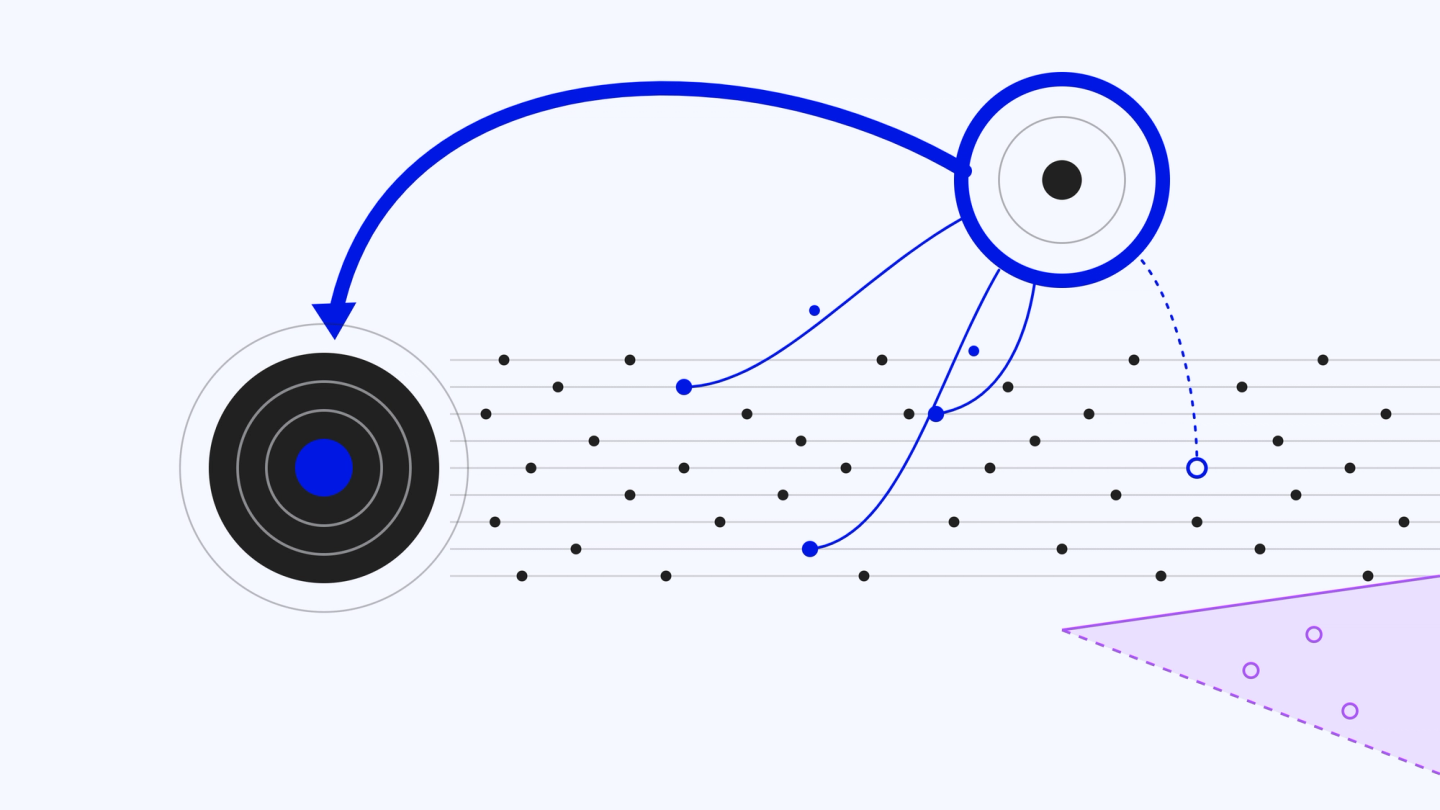
Human-in-the-loop is usually described as "humans reviewing machine output." That description is why most HITL systems are badly built. It frames the human as a safety net bolted on after the model, when the human is actually part of the model's operating logic. This guide explains what HITL is, why it exists, where the human belongs, and how to design a loop that gets cheaper over time instead of more expensive.
What HITL actually is
Human-in-the-loop (HITL) machine learning is a system design in which humans review, correct, or approve model outputs at defined points, and those corrections flow back into the model as training signal.
That is the textbook version. Here is the working version.
A model in production does three things: it predicts, it scores its own confidence, and it acts. HITL is what you build when you trust the first, doubt the second, and cannot afford the third to go wrong.
One more pair of definitions, because they get confused constantly. Automation is a model acting on its own output. HITL is a routing decision: a standing rule about when the model is allowed to act alone and when it must ask a person. The quality of a HITL system is the quality of that routing rule. Everything else is staffing.
Why models need humans: the confidence gap
A 96% accurate model sounds finished. It is wrong 40,000 times per million decisions. The question is never whether it fails. The question is whether anyone finds out.Here is the mechanism. A model's confidence score reflects how similar an input is to what the model saw in training. Confidence tells you where the model has been. It does not tell you whether the model is right. On familiar inputs, confidence and correctness track each other well. On unfamiliar inputs, they come apart: the model can be confidently wrong, because nothing in its training taught it what it doesn't know.And production data drifts. Cameras get remounted. Suppliers change packaging. Users start phrasing requests differently. The world moves away from the training set a little every week, and the model's errors migrate into exactly the regions where its confidence is least trustworthy.Call this the confidence gap: the space between how sure a model is and how right it is. Every model has one. It widens silently, because a wrong prediction and a right prediction look identical on a dashboard. HITL is the system you build inside the confidence gap. Its job is to convert silent failures into caught failures, and caught failures into training data.
Where the human goes: three loops, not one
People say "the loop" as if there is one. There are three, and they need different humans.
The first is the training loop.
Humans create the labeled data the model learns from, whether that is bounding boxes on factory images or preference rankings between two LLM answers. This loop runs before deployment and never really stops, because every model update needs fresh data. The humans here need deep familiarity with the guidelines, and their disagreements are information: if trained annotators can't agree on what "occluded" means, the model will inherit that disagreement as noise it can never train its way out of.
The second is the inference loop.
The model runs in production, and some slice of its predictions gets routed to a person before anything acts on them. Which slice is the whole design question, and we'll get to it.
The third is the feedback loop, and it is the one most teams forget to build.
Every human correction from the inference loop is a labeled example of the model failing on real production data. That is the most valuable training data you can get, because it is sampled from exactly where your model is weakest. If corrections go into a ticket queue and die there, you are paying for HITL and receiving quality control. If corrections flow back into training, you are paying the same money and receiving a model that improves. Same humans, same cost, entirely different asset.
Two teams, one model
Two teams deploy the same defect-detection model on the same kind of production line. Both models test at 96% accuracy.
Team A automates fully. Every prediction acts on its own. Their cost per inspection is nearly zero and their launch announcement writes itself.
Team B routes the model's least confident 8% of frames to human review, plus a random 2% sample of the confident ones. Their cost per inspection is higher, and their launch is a week later because they had to build the routing.
For a while, Team A looks smarter. Our money is on Team B, every time. Then the upstream supplier changes a material, a new defect type appears, and the model, which has never seen it, waves it through with high confidence. Team A finds out when a customer does. Team B found out in the first week, because the new defect surfaced in the low-confidence queue, a reviewer flagged it, and thirty corrected frames went back into training before it ever became a customer's problem.
Notice the random 2% in Team B's design. That is not paranoia. The confidence gap means some errors hide behind high confidence, so a loop that only reviews low-confidence predictions audits the model everywhere except where it is confidently wrong. Always sample the confident slice.
What good loop design actually looks like
Four decisions determine whether a HITL system works.
First, the escalation threshold.
What confidence level, or what stakes level, triggers human review? This is an economics question, not an ML question: route to a human whenever the cost of review is lower than the expected cost of an uncaught error. A wrong product tag costs a click. A wrong scaffolding-complete label costs a safety incident. Same model architecture, completely different thresholds.
Second, the reviewer.
A generic reviewer catches generic errors. The errors that matter are domain errors, and they need reviewers trained on your guidelines with calibration checked against a gold set, not whoever is free this week.
Third, the feedback path.
Corrections must land in the training pipeline on a schedule, with someone accountable for retraining. A loop that never closes is just an expensive inspection department.
Fourth, the measurement.
Track your override rate, the share of model outputs humans change. Falling override rate means the model is learning and you can narrow the review slice. Rising override rate means drift, and it is the earliest warning you will get. The override rate is the vital sign of the whole system.
What we've seen in production
The honest limit
We've watched this happen on our own floor, so we'll name it plainly. There is one problem HITL does not solve, and as far as we can tell nobody has: reviewer attention decays. A person approving their four-hundredth prediction of the day starts agreeing with the machine, and the loop quietly becomes a rubber stamp that costs money and catches nothing. We contain it rather than cure it: we seed known errors into every reviewer's queue and measure whether they get caught, so attention is a number we watch instead of a virtue we assume. If a vendor tells you their reviewers don't rubber-stamp, ask how they would know.
Where to start
Don't start by hiring reviewers. Start by finding your confidence gap: pull one week of production predictions, have a qualified human relabel a random thousand, and compare. The disagreements will tell you your real error rate, where it clusters, and what your escalation threshold should be. Design the loop around what you find, and make sure every correction has a road back into training.Run the thousand-prediction audit before you spend another dollar on automation.
If you want a second pair of eyes on the audit, send us a sample of your model's outputs. We'll show you where your confidence gap lives.
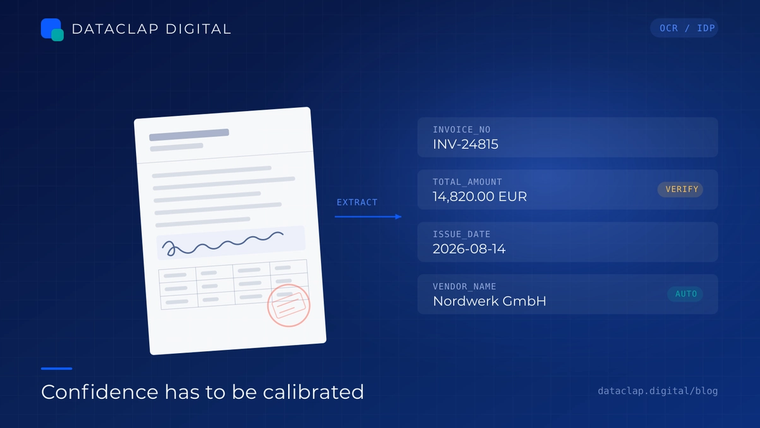
Document AI Beyond OCR: Designing an IDP Pipeline for Handwritten and Multi-Language Forms
Extraction accuracy on printed invoices says little about performance on a smudged claim form in three languages. Here is how to design a document pipeline where confidence is calibrated, humans handle the right 8%, and every correction becomes training data.